
 Notredame Lab
Computational Biology and Health Genomics
- Group page
- Research lines
- Group members
- Publications
- Datasets
- Software


1997-1999 Post Doctoral researcher at ISREC (Lausanne) and NIMR-MRC (London).
2000-2001 Assistant Professor, Marseilles University/CNRS-IBSM.
2001-2007 CNRS investigator, IBSM (Marseille).
2001-2005 Assistant Professor, Lausanne University. Group Leader at the Swiss Bioinformatics Institute (SIB) and member of the SIB executive board.
Since 2007 Senior Group Leader in the Bioinformatics and Genomics Programme, at the CRG (Barcelona)
News
A new tool that simultaneously compares 1.4 million genetic sequences can classify how species are related to each other at far larger scales than previously possible.
In a paper, published in Nature Ecology & Evolution, scientists have now demonstrated that Leishmania adaptation results from frequent and reversible chromosomal amplifications. Such variations, named aneuploidies, are similar to those occurring in many cancer types.
Nextflow contributes to establishing good scientific practices and provides an important framework for those research projects where the analysis of large datasets are used to take decisions, for example, in precision medicine.
Genomic analysis of the Iberian lynx confirms that it is one of the species with the least genetic diversity among individuals, which means that it has little margin for adaptation.
Summary
The main focus of the group is the development of novel algorithms for the comparison of multiple biological sequences. Multiple comparisons have the advantage of precisely revealing evolutionary traces, thus allowing the identification of functional constraints imposed on the evolution of biological entities. Most comparisons are currently carried out on the basis of sequence similarity.
Our goal is to extend this scope by allowing comparisons based on any relevant biological signal such as sequence homology, structural similarity, genomic structure, functional similarity and more generally any signal that may be identified within biological sequences.
Using such heterogeneous signals serves two complementary purposes:
(i) producing better models that take advantage of the signal evolutionary resilience,
(ii) improving our understanding of the evolutionary processes that lead to the diversification of biological functions.
All the applications related to our work are provided to the community through an international network of web servers that can be accessed from http://www.tcoffee.org
Ongoing projects include:
- Analysis of Copy Number Variations in eukaryotic genomes
- Improvement of RNA Multiple Sequence Alignments
- Post Processing of Multiple Sequence Alignments
- Benchmarking and Validation of Multiple Sequence Alignment Methods
- Combination of sequence and structural information
- Protein Structure comparisons
- Incorporation of Genomic information within multiple sequence alignments
- Analysis of the sequence/function relationship
- Multiple Genome Comparisons
- Evolution of Bacterial genomes
Funding acknowledgements


The "VEIS-Valorisation of EGA for Industry and Society" (VEIS-001-P-001647) project is cofunded by the European Regional Development Fund of the European Union in the framework of the ERDF Operative Program of Catalonia 2014-2020, with a grant of 1,951,429.38 EUR, with the support of the Department of Research and Universities of the Government of Catalonia.

Title: “Multiple sequence alignment scale up using predicted structural information (SEQALUP)”
Total budget: 200,000 €
Period: 01/09/2021 to 31/08/2024
Ref.: PID2020-115557GB-I00_Notredame
The project PID2020-115557GB-I00_Notredame has been funded by the Spanish Ministry of Science and Innovation and the State Research Agency (PID2020-115557GB-I00_Notredame/ AEI / 10.13039/501100011033)
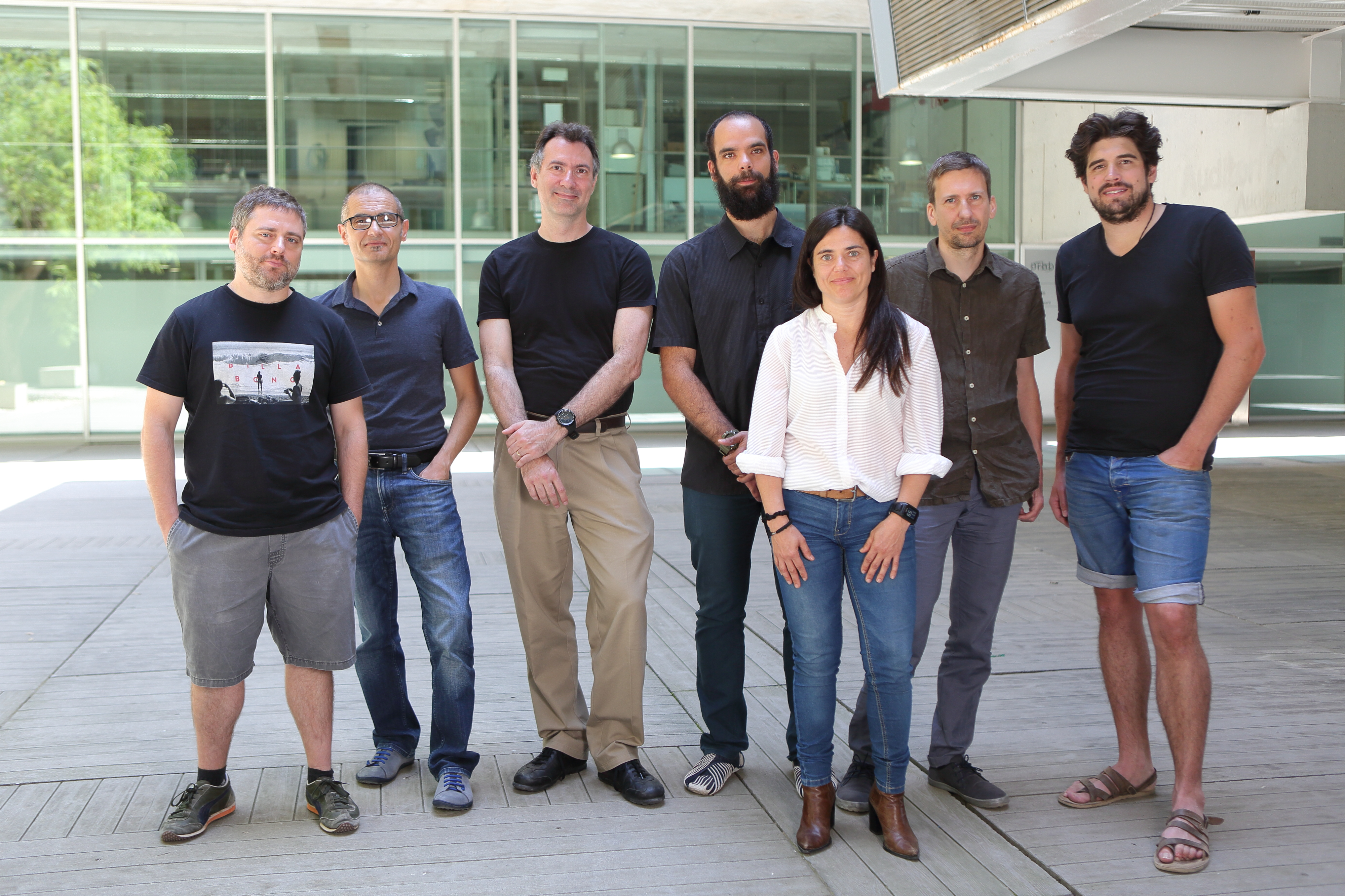
Group Leader
Postdoctoral Researchers
PhD Students
Postdoctoral Researchers
PhD Students
Nextflow is a pipeline orchestration tool that provides a domain specific language (DSL), meant to simplify the writing of complex distributed computational workflows in a portable and replicable manner. It allows the seamless parallelization and deployment of any existing application with minimal development and maintenance overhead, irrespective of the original programming language.
T-Coffee is a multiple sequence alignment package.
T-Coffee is a multiple sequence alignment package. You can use T-Coffee to align sequences or to combine the output of your favorite alignment methods (Clustal, Mafft, Probcons, Muscle, etc.) into one unique alignment (M-coffee). T-Coffee can align Protein, DNA and RNA sequences. It is also able to combine sequence information with protein structural information (Expresso), profile information (PSI-Coffee) or RNA secondary structures (R-Coffee).